

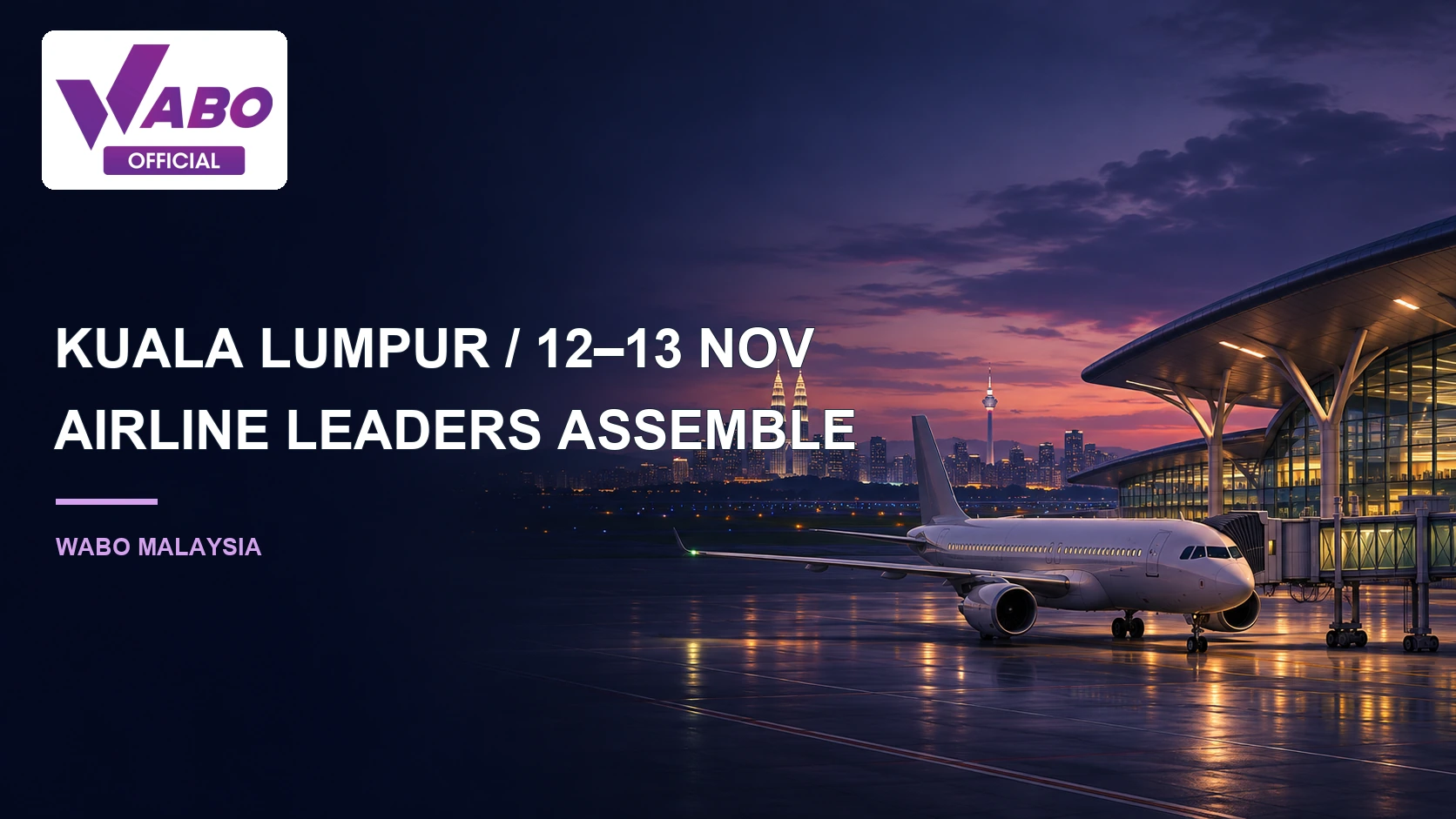
Kuala Lumpur is preparing to host senior Asia-Pacific airline leaders on 12–13 November, with Malaysia Airlines staging the Association of Asia Pacific Airlines’ 70th Assembly of Presidents. The airline’s 6 November announcement places operational resilience, supply-chain pressure, sustainability and regional cooperation on the agenda.
For WABO Malaysia readers, this is a timely industry story with a practical connection to travel: airlines need dependable aircraft, operating capacity and coordination as well as demand. As of this report on 10 November, however, the assembly is still ahead. Its announced agenda should not be confused with decisions that have already been adopted.
What is scheduled in Kuala Lumpur
The host says leaders from AAPA’s 18 member airlines are expected alongside government representatives, regulators and industry partners. Malaysia Airlines is the association’s 2026 chair. The meeting’s theme connects growth, resilience and innovation, bringing commercial development and the ability to withstand disruption into the same discussion.
AAPA’s own event notice confirms the dates and location and describes participation as invitation-only. This is a gathering of airline executives and senior stakeholders, rather than a public travel fair. Readers looking for tickets, holiday packages or a consumer exhibition should therefore distinguish this assembly from an event designed for public attendance.
The latest traffic figures show a mixed backdrop
AAPA’s preliminary September release, issued on 29 October, reported 30.4 million international passengers, up 0.7 percent from a year earlier after five consecutive months of decline. Passenger traffic measured in passenger-kilometres rose 5.9 percent, while available seat-kilometres increased 6.8 percent. The passenger load factor was 80.2 percent, down 0.6 percentage points.
Those measures answer different questions. Passenger numbers count people, whereas passenger-kilometres also reflect distance travelled. Capacity measures the seats and distances offered. Growth in one series need not match growth in another. Read together, the figures describe an uneven operating picture rather than a simple claim that every part of the market is expanding at the same rate.
Demand and operational capacity have to move together
The host announcement identifies supply-chain bottlenecks and operating costs among the issues facing airlines. These are relevant to the meeting because adding demand does not automatically add usable capacity. An airline’s ability to deliver a schedule depends on more than the number of people willing to book it.
The useful question after the assembly will be whether participants describe concrete responses: responsibilities, cooperation mechanisms or measurable improvements. A broad commitment to resilience is a starting point, not a completed operational change. For passengers, a later announcement backed by a clear implementation plan would be more informative than assuming that a two-day gathering itself resolves existing pressures.
Cargo adds another dimension to the discussion
The same AAPA release reported September international air-cargo demand up 6.4 percent in freight tonne-kilometres, against a 4.9 percent increase in capacity. Its freight load factor reached 60.3 percent. These freight measures belong to a different part of the aviation business from passenger seat occupancy.
This distinction helps explain the breadth of an airline-industry assembly. A single headline about passenger growth cannot capture every operating segment. The statistical release also uses an aggregate sample of 36 Asia-Pacific carriers, which is larger than AAPA’s 18-airline membership. The figures provide regional context; they are not a performance report for only the organisations expected at the meeting.
Sustainability requires coordination beyond an individual airline
AAPA’s environmental overview identifies technology, operations, infrastructure and market-based measures as parts of its approach. It also points to airspace inefficiency and operating restrictions as factors that can complicate airlines’ own efforts. That background helps explain why regulators and wider industry partners matter to the conversation.
The editorial implication is that evaluating a future announcement will require attention to who can actually implement it. A change in aircraft operations, an infrastructure investment and an airspace measure involve different responsibilities and timescales. Combining them under a broad sustainability heading may be convenient, but separating the actions makes subsequent progress easier to assess.
What Malaysian readers should watch after the meeting
The next useful update will be the assembly’s published outcomes. Look for confirmed joint actions and their scope, rather than treating every discussion topic as an approved policy. If a new initiative is announced, the important details will include the participating organisations, the intended result and any stated timetable.
Nothing in the pre-event materials establishes lower airfares, a new route or an immediate change to a passenger’s booking. Existing travel arrangements should still be checked through the relevant airline. The significance of this week’s meeting is its opportunity to turn shared industry pressures into specific cooperation; whether it does so will depend on the evidence released afterwards.
Sources and further context
- Malaysia Airlines: Kuala Lumpur assembly announcement
- AAPA: 70th Assembly of Presidents
- AAPA: September 2026 preliminary traffic figures
- AAPA: environmental priorities
Frequently asked questions
When is the assembly?
AAPA and Malaysia Airlines confirm 12–13 November 2026 in Kuala Lumpur.
Can the public attend it as a travel fair?
AAPA describes participation as invitation-only. It is an airline-industry assembly, not a public holiday exhibition.
Do the traffic figures cover only AAPA’s 18 members?
No. The September preliminary statistical release uses an aggregate sample of 36 Asia-Pacific carriers.
Have new passenger policies already been agreed?
The cited pre-event announcements describe an agenda. Specific outcomes must be checked in subsequent official releases.